Helport: AI Copilot for Live Calls
An AI co-pilot that guides health insurance agents through live calls with real-time, policy-aware answers, built-in compliance safeguards, and automated call summaries.
Why We Built This
of insured adults report at least one issue with their health insurance coverage every year
say they were unable to receive recommended care due to insurance hurdles
annual attrition among the ~70,000 customer service reps at health and medical insurance carriers
Health insurance support in the U.S. is breaking down at scale — for the members trying to use their coverage and the agents trying to help them.
U.S. health insurers collectively cover around 300 million Americans, and the industry is already signaling it's ready for AI — CVS Health kicked off a multiyear $2B cost-cutting effort, and UnitedHealth's CTO has said AI investment is core to fixing a health care system that needs it.
Three ways it breaks down

Member Confusion
Members can't tell what's covered, get inconsistent answers, and face delays that affect their health.
Agent Overload
Agents juggle fragmented systems and complex policies, driving long calls, escalations, and compliance risk.
Systemic Inefficiency
Outdated tools drive slow, error-prone support: repeated calls, higher costs, preventable violations.
The problem
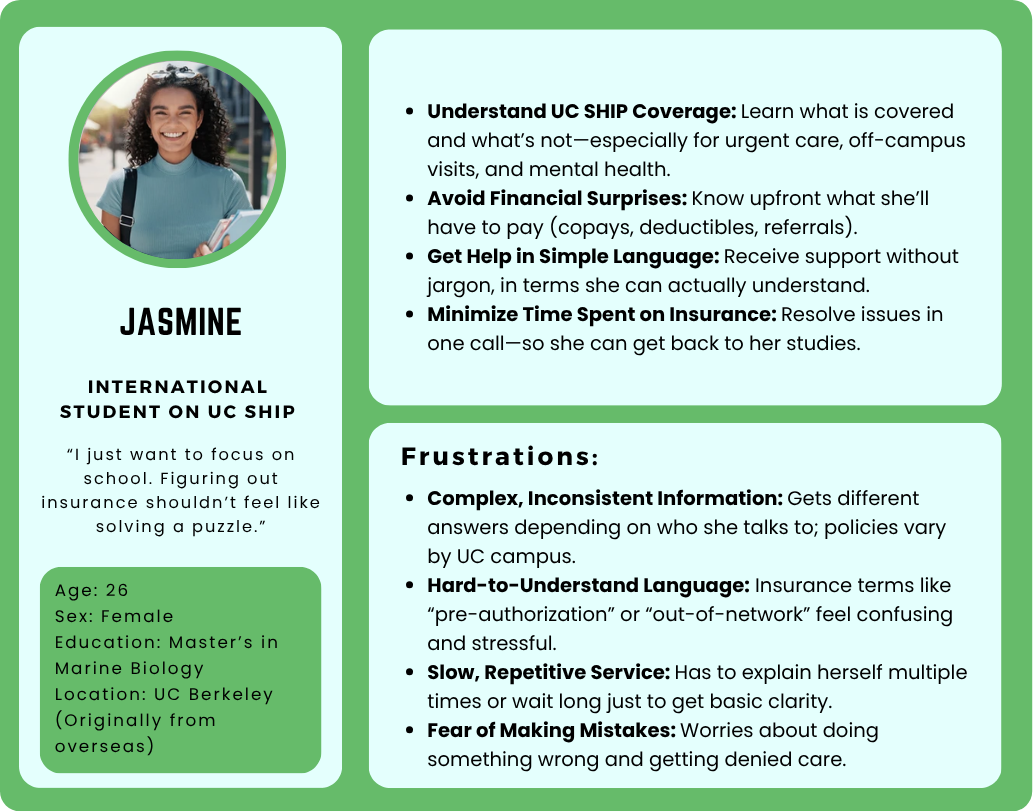
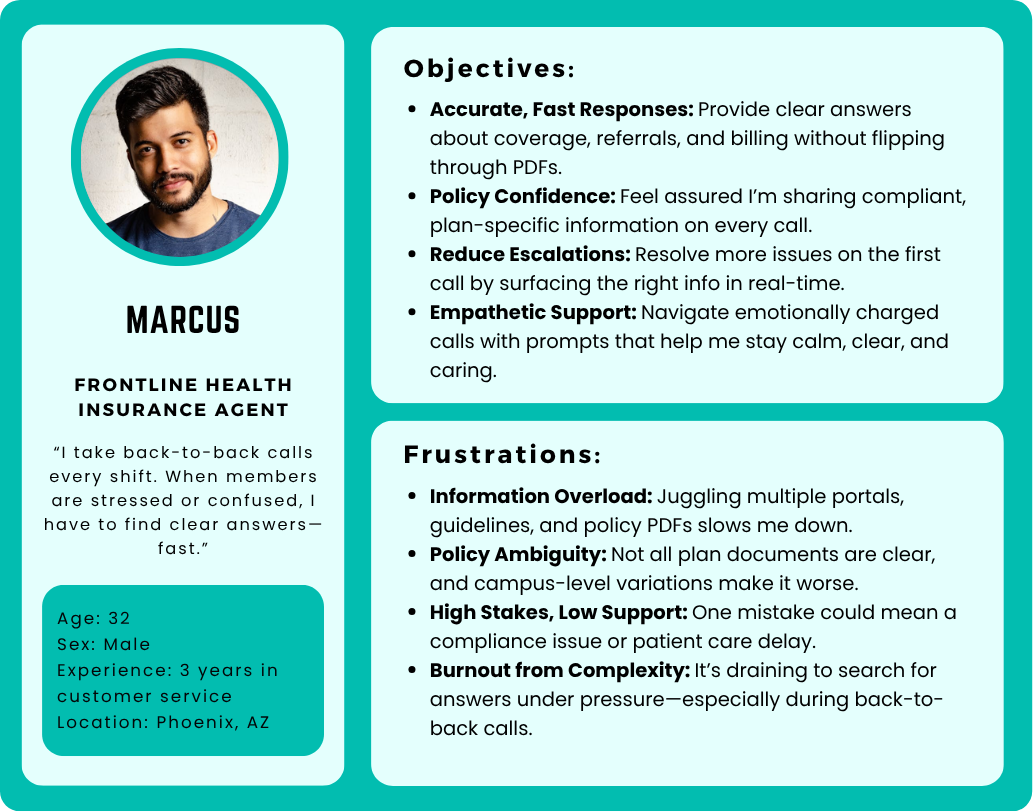
A frontline health insurance agent taking back-to-back calls needs to give an accurate, plan-specific answer while the member is still on the line, because the answer is scattered across portals and policy PDFs that vary by campus, and getting it wrong means a compliance violation or a delay in someone's care.
Built to fix it
We turn overwhelmed insurance calls into confident conversations — cutting through confusion with instant answers, clear guidance, and seamless follow-up.
Realtime Policy-Aware Guidance
Empowers agents with instant, plan-specific answers triggered by live call transcription.
Streamlined, Scripted Workflows
Uses guided speech navigation to walk agents through complex, multi-step processes.
Built-In Compliance Safeguards
Detects and flags HIPAA/CMS risks during live calls, providing real-time corrective prompts to avoid legal violations and protect star ratings.
Automated Call Summaries
Generates post-call summaries outlining key issues, coverage info, and next steps.
Both sides of the call
Who we're built for
Self-funded commercial and student plans
- UC SHIP is self-funded by the University of California, with medical claims administered by Anthem Blue Cross
- Anthem is who runs the member services line, so Anthem is who buys
Contact center BPOs
- Alorica and Teleperformance staff outsourced insurance support and are measured directly on handle time
- Shortest procurement cycle of any segment
Medicare Advantage carriers
- Plans like SCAN Health Plan, a Long Beach nonprofit MA plan
- Value here includes CMS Star Ratings and CAHPS, which commercial plans don't have
- Roughly 70,000 customer service reps work for health and medical insurance carriers (BLS)
- At $130 per seat per month, about $109M annually, before counting BPO agents
- Roughly 30% annual agent attrition means constant retraining
- Margin pressure across the sector is pushing spend toward cost per call
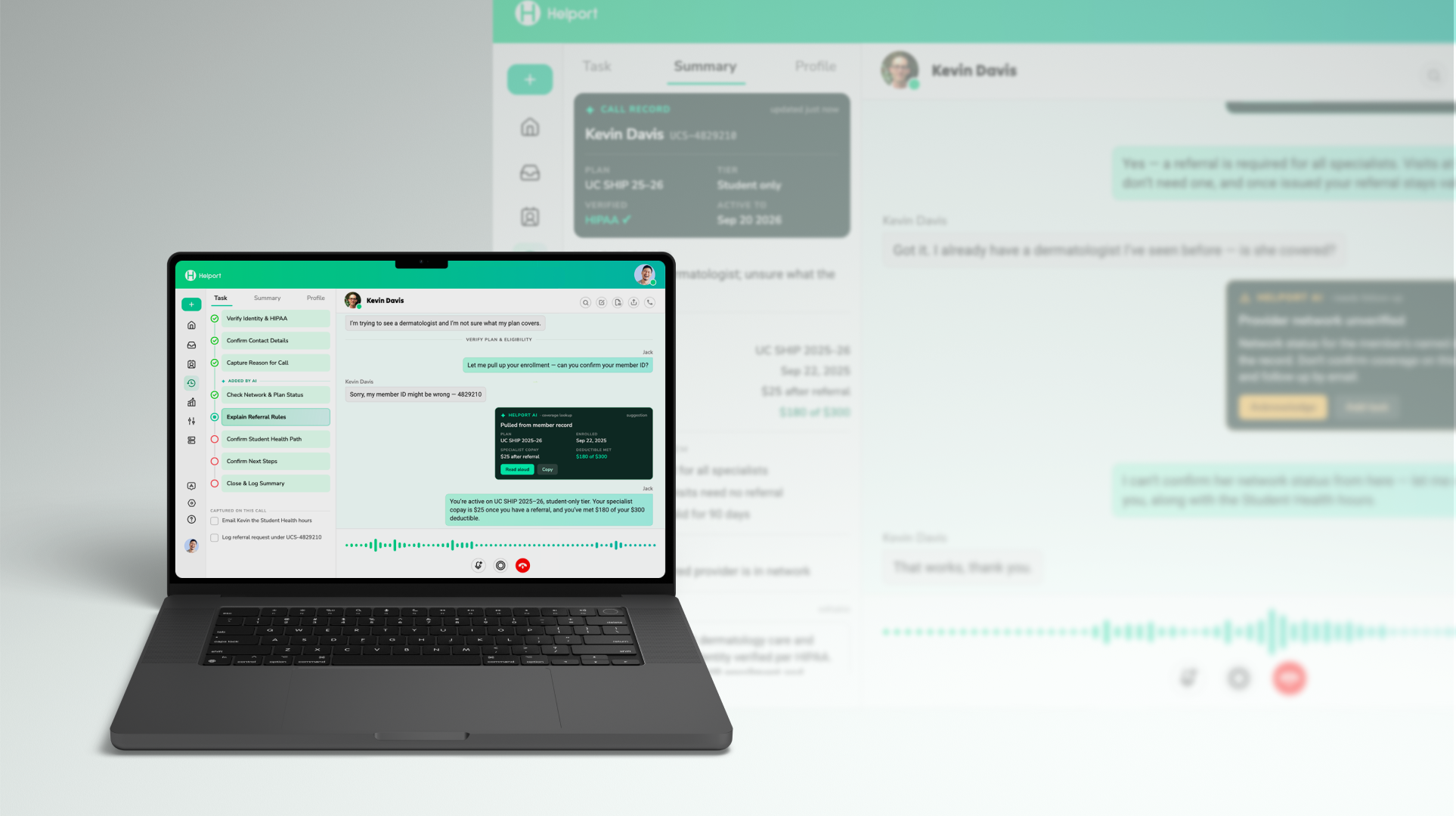
Inside a call
LayerCo-Pilot
Layer
Layer
Layer
Demoed against UC SHIP, the University of California student health plan — a natural fit since 58% of insured adults report a coverage issue every year, and international students hit that confusion without a support system they already know.
Design Process
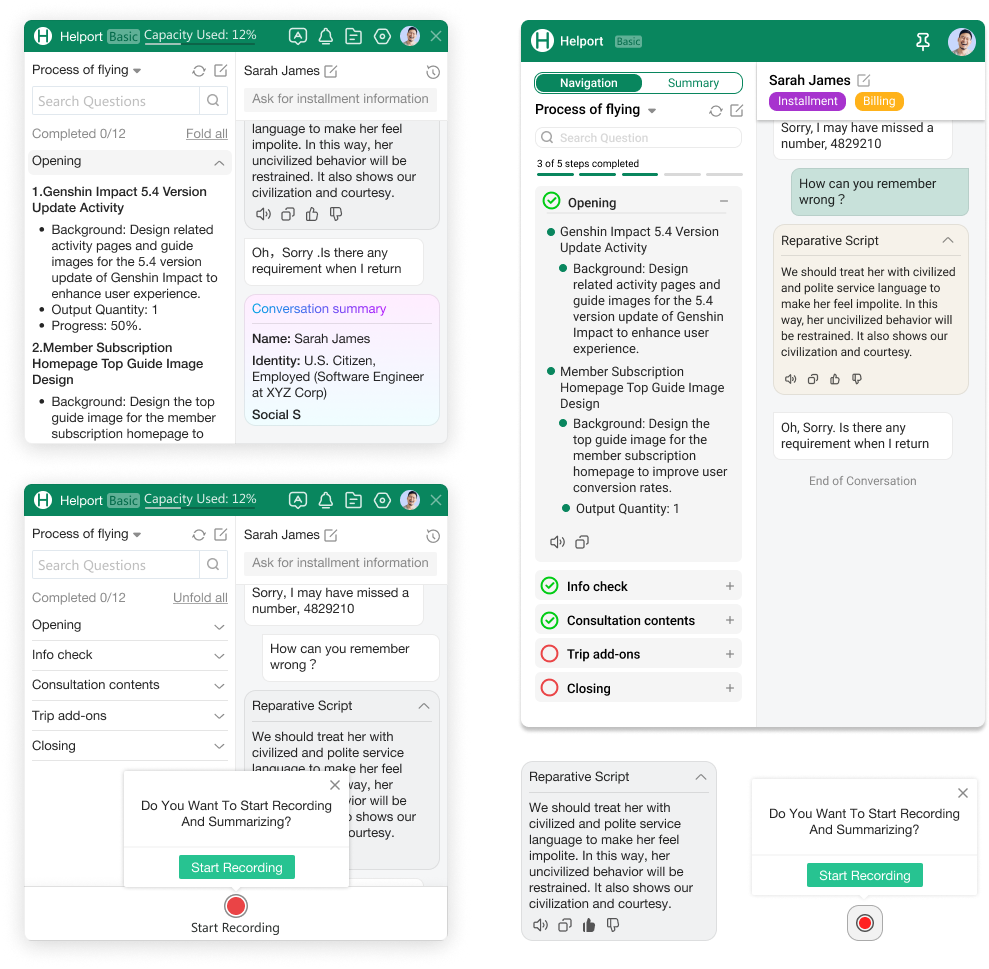
Weak visual hierarchy
Scripts, messages, workflow steps, and summaries competed for attention.
High information density
Nested sections and long text blocks increased the amount of information agents had to process during a call.
Unclear AI guidance
AI recommendations blended into the conversation, making them harder to distinguish from customer and agent messages.
Disconnected call controls
Recording relied on a separate modal, interrupting the live workflow.
Buried next steps
Agents could see the workflow, but completed and pending actions were not immediately clear.
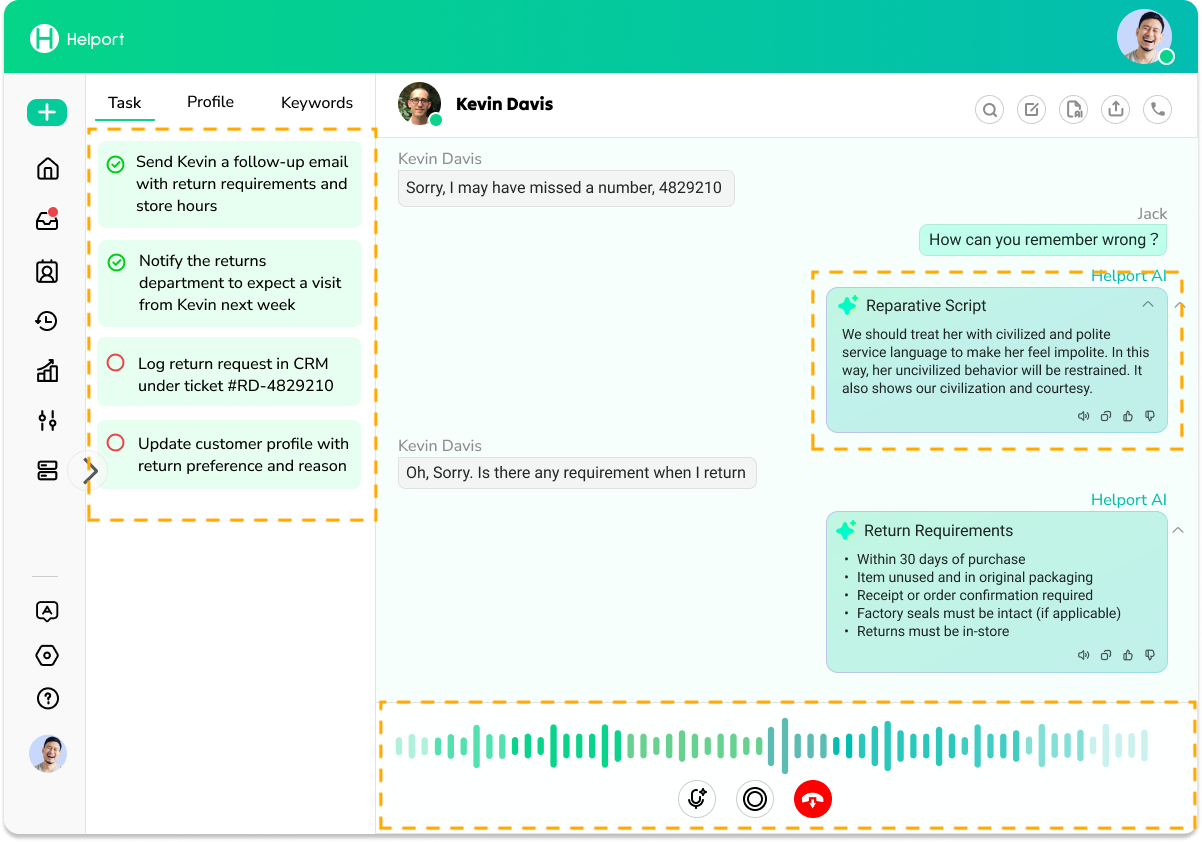
Clear AI guidance
Separated AI recommendations from agent and customer dialogue.
Actionable task tracking
Simplified workflows into clear, easy-to-follow steps.
Integrated call controls
Kept essential call actions accessible without interrupting the workflow.
Stronger visual hierarchy
Reduced distractions and made it easier to identify what to say, what to do, and what comes next.
Stay on track throughout the call
A real-time task list adapts to the call purpose and conversation, automatically updating completed and remaining actions so agents always know what to do next.
Verify members without manual lookup
The system identifies the member using their ID and existing records, then surfaces relevant profile and plan information for verification, reducing repetitive searches and saving time at the start of each call.
Get the right information at the right moment
When a member asks a specific question, AI retrieves relevant information from the knowledge base and presents it directly in the conversation, helping agents respond accurately without memorizing policies or searching through documentation.
Turn every conversation into actionable documentation
After each call, AI automatically organizes the interaction into a call summary, key notes, follow-up actions, transcript, and recording, reducing manual documentation and making the conversation easier to review later.
Where Helport fits
.png)
.png)
.png)
Customer self-service & call automation
Real-time agent assistance
Enterprise CX automation
- Call automation & smart routing
- Self-service & SMS deflection
- Healthcare-specific workflows
- Real-time guidance
- Knowledge assist & next-best actions
- Automated summaries
- Conversation intelligence
- Broad CX platform
- Agent copilots
- QA, analytics & WFM
- Enterprise integrations
- Primarily customer-facing
- Optimized for deflection/routing
- Broad enterprise platform
- More capabilities than a focused workflow requires
- Very broad platform
- Focus extends beyond individual agent workflow
Perceptual Map of Service Positioning
Helport AI fills the gap with focused real-time agent guidance, compliance support, and workflow automation, making it a strong fit for complex, policy-driven interactions like the UC SHIP demo.
Who pays, and how
Core platform plus compliance
One customer profile: 500 agents, 700K calls
The numbers
drop in average handle time
Saves up to 2,200 labor hours/month in a 100K-call operation
increase in first contact resolution
Fewer callbacks, escalations, and member frustration
industry cost per call
Even small time savings translate into hundreds of thousands in annual savings
potential reduction in HIPAA violation fees
Real-time QA and intelligent labeling help prevent costly HIPAA/CMS violations