On-device AI copilot connecting seniors, caregivers, and families through structured visit reports and symptom triage.
Why We Built This

My grandmother's caregiver messaged my mom with a concern. It got lost in her inbox. A few days later, grandma fell and ended up in the hospital.
That's the gap Alio was built to close.
An AI model can read through daily caregiver notes and surface what actually matters, before it gets buried. Running on-device, that same AI keeps the whole caregiver circle in sync — fast, private, and without anyone waiting on an inbox.
Research Results
family caregivers in the US, up 40%+ in a decade
patients 65+ bring family to appointments — the rest go alone
confusion point: non-daily medication dosing ("once a week" becomes "every day")
Home-based patients without formal caregivers have no one checking in between visits, no one catching a missed dose or a fall until it's too late. It's the same failure our research surfaced, information existing but never reaching the people who need it in time, and the gap Alio was built to close.
The problem
Caregivers generate constant, valuable information, but almost none of it reaches family or becomes clinically useful. What does get through arrives unstructured, easy to miss, buried in a text or an inbox until it's too late. Alio needed to turn raw caregiver input into something actionable: interpreted labs, triage, structured logs, and visit reports, without adding more work for an already stretched caregiver.
Competitive Analysis
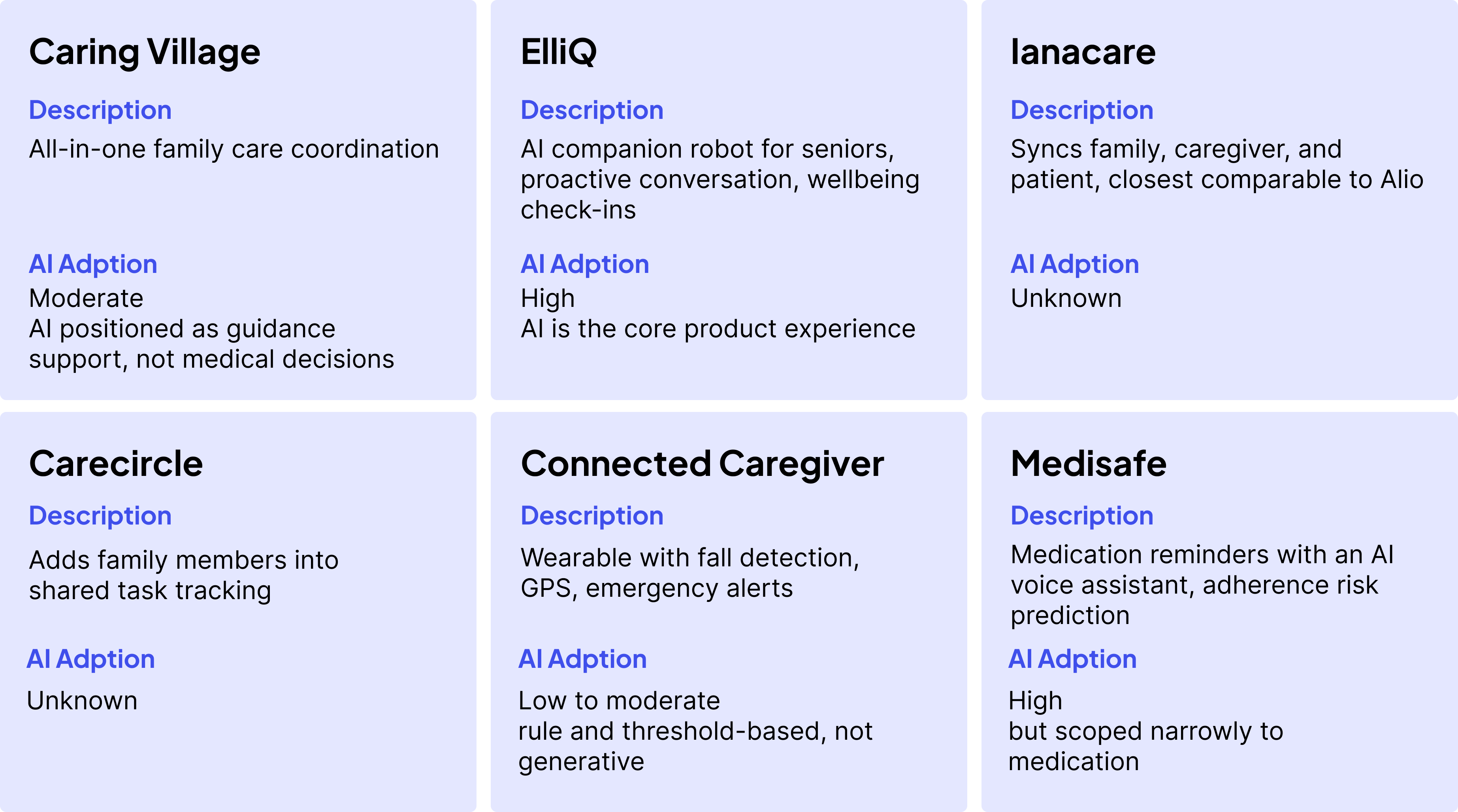
Coordination platforms solve who's involved but leave AI's role vague, still depending on someone checking an inbox. Platforms with real AI depth go deep on one function, companionship or medication, but none structure everyday caregiver input across the full picture.
The only one combining structured, AI-generated caregiver-to-family communication with clinical-grade output (interpreted labs, triage, structured logs) in one lightweight tool, not a device, not a single-purpose reminder app.
System Architecture
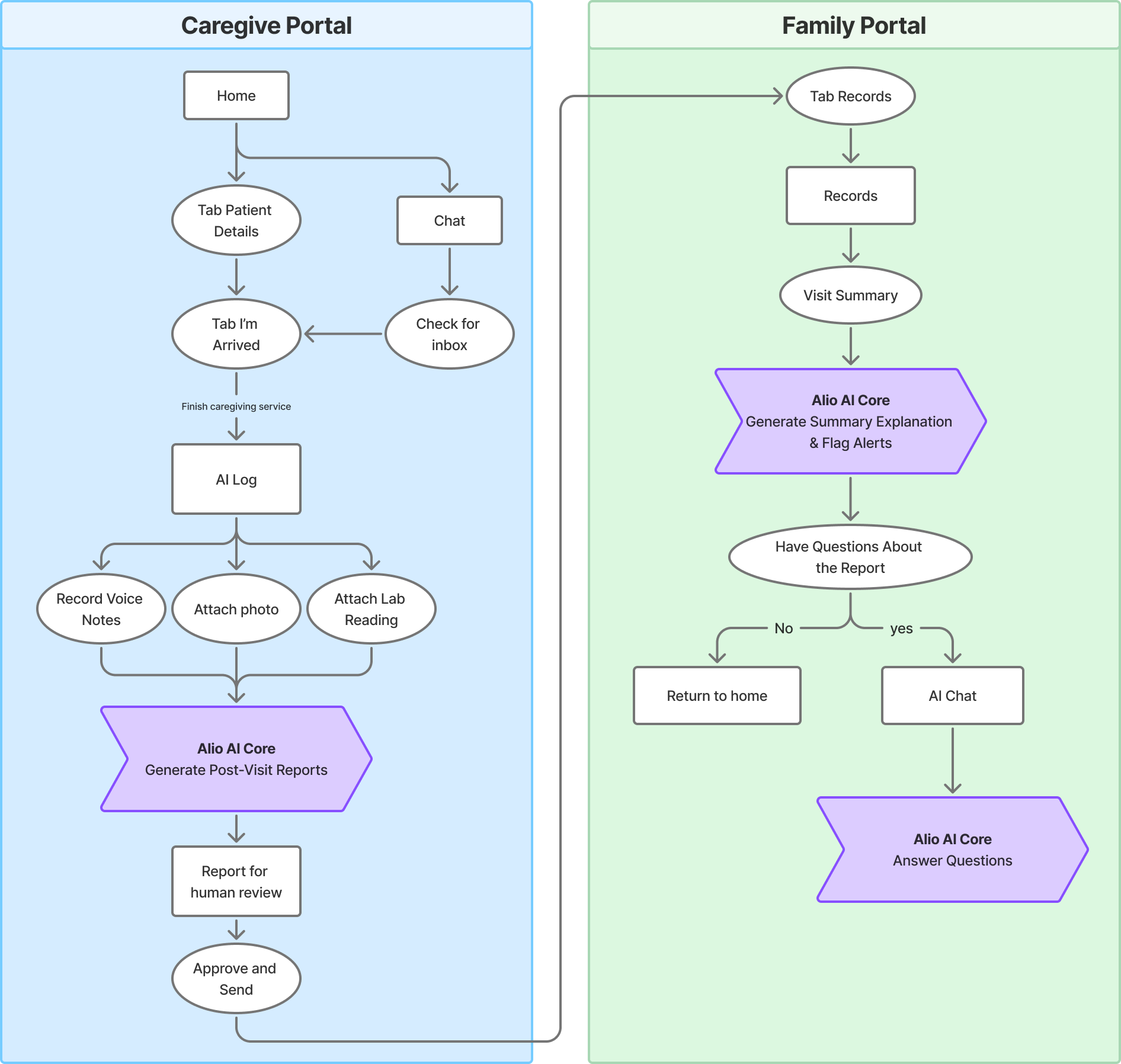
Two Portals, One System
Caregiver and Family are separate portals, connected by continuous shared updates.
One Model, Both Sides
The same AI core generates reports on the caregiver side, then translates and answers questions on the family side.
Always in the Loop
Reports and messages stay shared and up to date, so family is never catching up on what they missed.
Technical Stack
Prototype Demo
Real-Time Arrival & Status
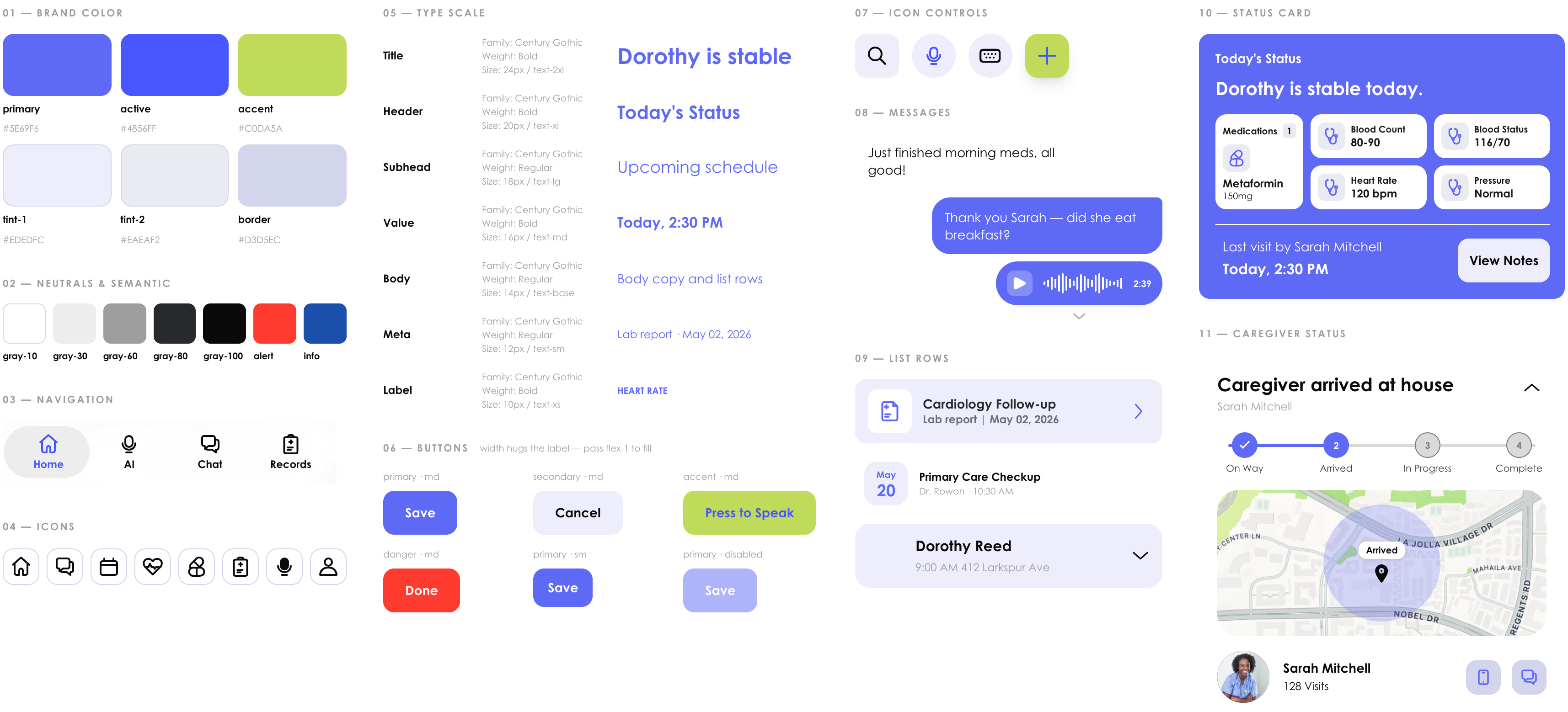
Caregivers keep patient details, address, and contact info on their portal. When a caregiver arrives, one tap marks the visit as started, and family receives an instant notification that care is underway.
Care Loop Messaging
Family can message the caregiver directly with specific requests, everything kept as a permanent record. Multiple family members can join the same care loop, so a caregiver's response reaches everyone at once instead of getting relayed secondhand.
AI Visit Log & Post-Visit Report
At the end of a visit, the caregiver records a voice memo. Alio's fine-tuned model turns that into a structured post-visit report, then flags anything that needs family's attention. Once the caregiver approves it, the report syncs to the family portal.
Family Q&A with AI
After receiving a report, family can ask Alio follow-up questions directly. The model draws on the full patient history and logs to give specific, informed answers, general guidance and context, not diagnosis, especially useful when family has lost track of earlier details.
Built to scale
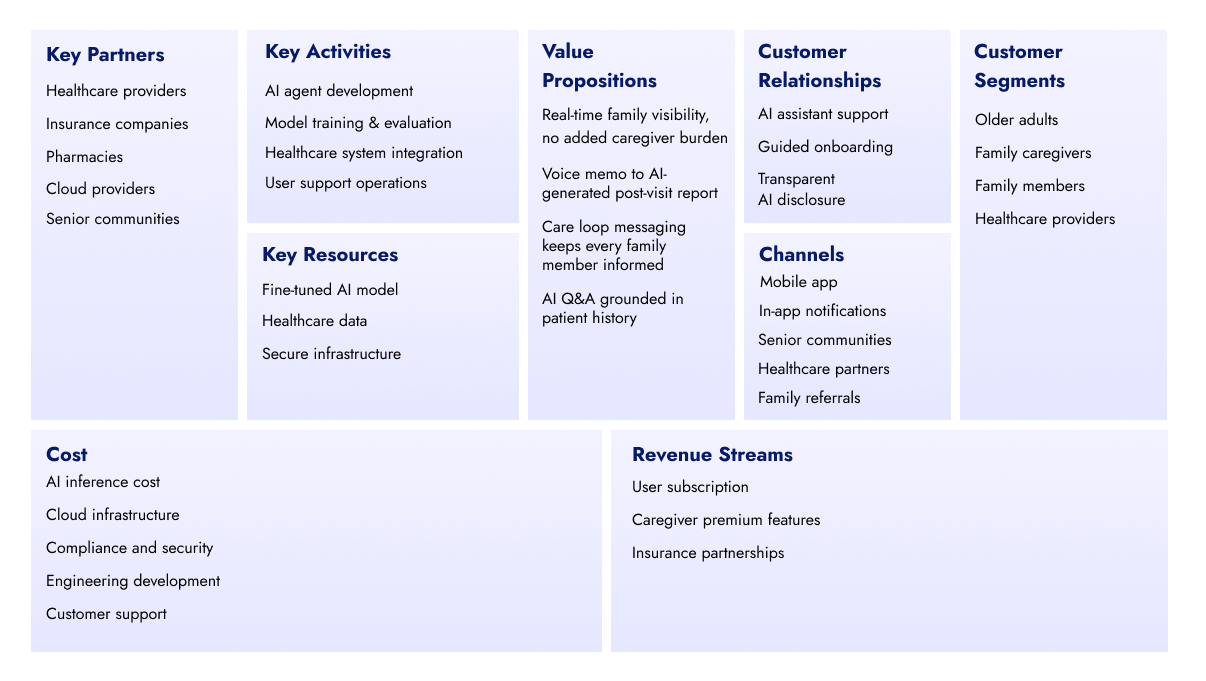
Business Model Canvas
AI Product Roadmap
Phase 1 — MVP
Ship the core loop, caregiver to family
- • Build caregiver and family portals
- • Voice memo to AI-generated report
- • Mandatory caregiver review before delivery
Phase 2 — Near-Term
Make AI output something family can rely on
- • Family Q&A grounded in patient history
- • Push notifications for urgent flags
Phase 3 — Mid-Term
Support more complex care situations
- • Multi-caregiver support
- • Trend detection across visits
Phase 4 — Long-Term
Connect Alio to real clinical care
- • Consent-based provider integration
- • Deeper personalization over time
Responsible AI
| Risk | Impact | Safeguard |
|---|---|---|
| Sensitive health data exposure | Symptom, medication, and behavioral data leaving the device could expose vulnerable seniors to privacy breaches | On-device inference, data never leaves the device to generate a report |
| AI misdiagnosis or false reassurance | A wrong or overconfident AI read on a symptom could delay real care or cause unnecessary alarm | Flag-only outputs, the model surfaces concerns for a human to evaluate, never issues a diagnosis or standalone recommendation |
| Errors reaching family unchecked | A misread voice log or hallucinated detail could reach family as if it were verified fact | Mandatory caregiver review, no report reaches family without human approval first |
| Family over-relying on AI for medical guidance | Follow-up questions in the family portal could be mistaken for actual clinical advice | Scoped Q&A, responses stay general and history-grounded, explicitly not diagnostic |